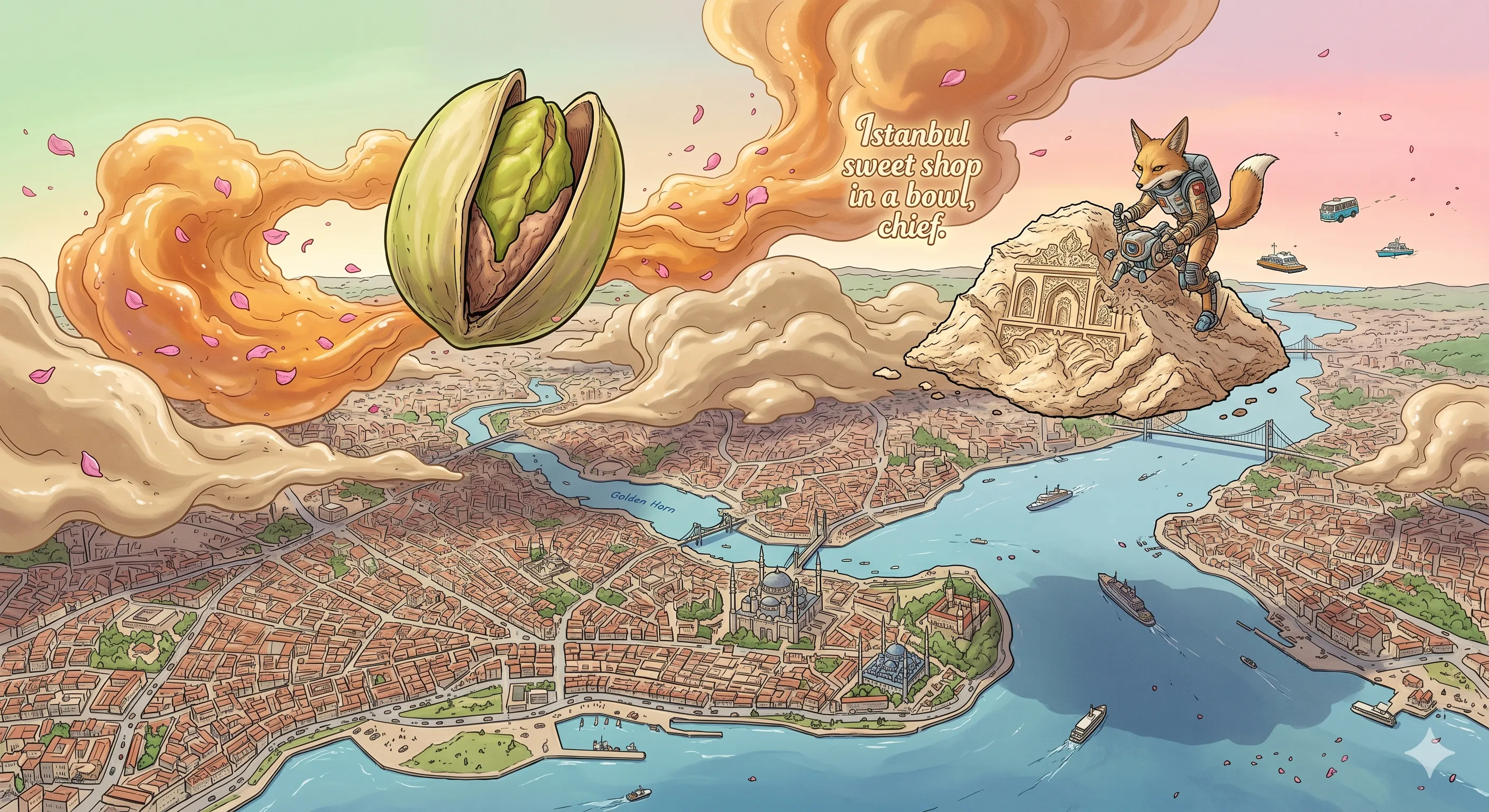
Tahini Rose
Turkish sesame sweetness meets delicate floral notes
Tahini is oily and thick, which means it can split your custard if you're not careful about integration. Rose water is potent as fuck and the line between "delicate floral" and "soap factory" is thinner than you think. You're also working with halva, which has a specific crumbly-but-cohesive texture that you need to respect. Plus candying pistachios. None of this is technically hard, but you need to pay attention and follow the steps in order or you'll end up with a grainy, soapy mess. Not trying to scare you, just being real.
Allergen Information: Contains tree nuts (pistachios).
Halva is one of those Middle Eastern confections that’s been around forever and shows up in about a dozen different forms across different countries. The Turkish version—tahini-based halva with that distinctive fibrous, flaky texture—is what we’re channeling here, chief. It’s intensely sweet, nutty from the sesame, and has this almost chalky mouthfeel that sounds weird but is actually addictive as hell.
Adding rose water is traditional in Turkish sweets—it cuts the richness and adds this haunting floral note that makes everything feel more elegant. The trick is using just enough to make people wonder what that flavor is without being able to name it. Too little and it disappears. Too much and you’ve made potpourri ice cream.
This ice cream is rich, complex, and definitely not for people who think vanilla is adventurous. But if you’re into Middle Eastern desserts or just want to make something genuinely different, this is your move.
Ingredients
Tahini Custard Base:
- 2 cups heavy cream
- 1 cup whole milk
- 2/3 cup sugar
- 4 egg yolks
- 1/3 cup tahini (well-stirred, high quality)
- 1 tsp vanilla extract
- 1/4 tsp rose water (start here, you can add more later)
- Pinch of salt
Candied Pistachios:
- 1 cup shelled pistachios (raw, unsalted)
- 1/4 cup sugar
- 2 tbsp water
- 1/2 tsp rose water
- Pinch of salt
Honey-Rose Swirl:
- 1/3 cup honey (good quality, not the squeeze bear kind)
- 2 tbsp water
- 1/4 tsp rose water
- Pinch of salt
Halva Chunks:
- 4-6 oz good quality tahini halva (plain or vanilla, not chocolate or other flavors)
Instructions
Candied Pistachios (make these first, can be done up to a week ahead):
Roughly chop the pistachios—you want pieces, not dust. Some whole ones, some halves, some smaller bits. Variety in size means better texture distribution.
Line a baking sheet with parchment. Combine sugar and water in a medium saucepan over medium heat, stirring until the sugar dissolves. Stop stirring and cook until it reaches 240°F (soft ball stage). This takes 5-7 minutes and requires a candy thermometer—don’t guess, pal.
Add the pistachios, rose water, and salt. Stir constantly. The mixture will crystallize and look like a grainy disaster—this is completely normal and exactly what should happen. The sugar is reverting to crystal form as it cools on contact with the room-temperature nuts and the water from the rose water. Keep stirring over medium heat and the sugar will melt again, turning into a glossy coating on the nuts. Takes about 3-5 minutes of constant stirring, and your arm will get tired. Push through it.
When the pistachios are evenly coated and starting to turn golden (they won’t get very dark because the rose water adds moisture that slows browning), spread them on the parchment in a single layer. Don’t clump them together or they’ll harden into one giant mass that you’ll have to attack with a hammer. Let cool completely—they’ll crisp up as they cool, transforming from sticky and soft to crunchy and candy-coated. Break into smaller clusters if needed. Store airtight.
Honey-Rose Swirl:
This is stupid simple. Combine honey, water, rose water, and salt in a small saucepan. Warm over low heat, stirring, just until everything is fluid and well combined—about 2-3 minutes. Don’t boil it or you’ll drive off the rose water’s delicate aromatics, which are volatile compounds that evaporate at relatively low temperatures.
Taste it carefully. You should get honey sweetness first, then a subtle floral note sneaking up behind it. If you can’t taste the rose water at all, add another 1/8 tsp. If it tastes like perfume—like you just bit into a bar of soap shaped like flowers—you’ve gone too far and you’ll need to add more honey and water to dilute it. Rose water is STRONG—respect it.
Let cool to room temperature, then refrigerate. Should be thick but pourable when cold, like honey that’s been sitting in the fridge. If it’s too thick (honey varies wildly in consistency depending on the source), warm it gently before using.
Make Custard:
Combine cream and milk in a saucepan and heat over medium until steaming—you want small bubbles forming around the edges but not a rolling boil. While that heats, whisk the egg yolks with the sugar in a separate bowl until pale and thick, about 2 minutes of solid whisking. This pre-mixing is important because it distributes the sugar evenly and starts dissolving it, which prevents graininess in the final custard.
Temper the yolks—you know this drill by now. Slowly drizzle about 1 cup of the hot cream mixture into the yolks while whisking constantly, then pour the tempered yolk mixture back into the saucepan with the rest of the cream. Cook over medium heat, stirring constantly with a wooden spoon or heatproof spatula, until it reaches 170-175°F and coats the back of a spoon. When you drag your finger through the custard on the spoon, it should leave a clear line that doesn’t immediately fill back in.
Integrate Tahini (THIS IS CRITICAL):
This is where people usually fuck up, so listen carefully. Remove the custard from heat. Scoop out 1 cup of the hot custard into a separate bowl. Add the tahini to this smaller portion and whisk vigorously until completely smooth—no streaks, no separation, no oil slicks floating on top, just uniform tan liquid that looks like peanut butter thinned with cream. This takes about 30 seconds of actual, aggressive whisking.
Now pour this tahini mixture back into the main pot of custard, whisking constantly as you pour. The gradual integration prevents the tahini from seizing up or separating into oil slicks that’ll make your ice cream look like a science experiment gone wrong.
Why this matters: Tahini is basically sesame butter—it’s thick, oily, and prone to breaking when you hit it with temperature changes. The proteins and fats in tahini exist in a delicate emulsion that can easily destabilize. By first mixing it with a smaller amount of hot liquid, you’re creating a stable emulsion that can then integrate with the full custard without splitting. Same principle as tempering chocolate or making mayonnaise—you’re managing the fat-to-liquid ratio carefully, allowing the proteins to gradually adjust to the new environment instead of shocking them.
Add the vanilla, rose water, and salt. Stir thoroughly until everything’s incorporated. The custard should be uniformly tan-beige with no oil slicks on top and no separation at all.
Strain through a fine-mesh sieve to catch any bits of cooked egg or any tahini that didn’t fully incorporate. Cool over an ice bath, stirring occasionally to prevent a skin from forming, then refrigerate at least 4 hours or overnight. Overnight is better—gives the flavors time to meld and develop complexity.
Prep Halva:
Break the halva into irregular chunks—think somewhere between pea-sized and chickpea-sized. Don’t make them too big or they’ll be hard to eat frozen, too small and they’ll disappear into the base. Halva is crumbly by nature—it wants to break apart, so this is easier than it sounds. The fibrous texture comes from whipping hot sugar syrup into tahini, which creates these protein-fat structures that give halva its distinctive pull-apart quality. Put these chunks in a container and keep them in the fridge until you’re ready to churn.
Churn and Assemble:
Taste the chilled custard base before churning, dude. You should taste subtle rose water—if you don’t taste it at all, add another 1/8 tsp and stir well, then wait 10 minutes and taste again. Better to add in small increments than to overshoot and end up with grandmother’s-perfume ice cream.
Churn until soft-serve consistency. Tahini makes this denser and richer than standard custard—more fat content, different protein structure—so it may take slightly longer than usual to thicken up. Don’t worry, just let it go until it’s properly thick and creamy.
Layer into your storage container: spread one-third of the ice cream, drizzle some honey-rose swirl in ribbons, scatter halva chunks and candied pistachio clusters. Repeat twice more, building up those layers. Use a knife to gently swirl the honey through—you want ribbons and pockets of concentrated sweetness, not complete integration where everything turns one uniform color.
Freeze at least 4 hours before serving.
Notes
Finding ingredients:
Good tahini makes a massive difference here. Cheap tahini tastes bitter and separates into a pool of oil with concrete-hard paste at the bottom. Get the stuff from Middle Eastern markets if you can—brands like Al Arz or Har Bracha. It should be smooth, pourable, and made from 100% sesame seeds with no added oils or sugar. The separated oil on top is completely normal—that’s just what tahini does when it sits. Just stir it back in before measuring, making sure you incorporate all that oil back into the paste.
For halva, check Middle Eastern, Turkish, or Mediterranean markets. You want plain tahini halva, not the chocolate kind or any other fancy flavors that’ll compete with the rose water. The texture should be firm but crumbly, with visible fibrous strands running through it when you break it open. Brands like Joyva (which you can find at some regular grocery stores) work fine in a pinch, but specialty brands from Turkish or Middle Eastern stores are usually fresher and better quality—less likely to be stale or rancid.
Rose water: Buy it from Middle Eastern or Indian grocery stores, or order online from places like Kalustyan’s. Make absolutely sure it’s food-grade rose water meant for cooking, not the cosmetic kind that’s in the beauty aisle. The bottles look similar but the cosmetic stuff often has additives that taste chemical and wrong. A little goes a long way—a 4 oz bottle will last you years because you’re using it by the quarter teaspoon.
Raw, unsalted pistachios are available at most grocery stores, but if you can find Turkish or Iranian pistachios at a Middle Eastern market, they’re worth the extra effort. More flavor, better texture, deeper green color. The difference is noticeable.
About rose water:
This is the ingredient that trips up most people who try Middle Eastern desserts at home, so pay attention. Too little and you won’t taste it—it’ll be a phantom flavor that doesn’t register. Too much and your ice cream tastes like your grandmother’s perfume, like you’re eating a bouquet of roses that’s been sitting in a hot car. The potency comes from the concentrated volatile compounds extracted from rose petals during distillation—mostly citronellol, geraniol, and nerol, which are the same compounds that make roses smell like roses. A tiny amount creates elegant floral complexity. Too much creates overwhelming perfume.
Rose water’s intensity varies wildly by brand, so always taste and adjust. The goal is a subtle, haunting floral note that you notice after a few bites, not an aggressive HELLO I AM ROSES assault on your palate when you take the first spoonful.
If you’re nervous about it, you can make the custard with just 1/8 tsp rose water and add more to taste before churning. Just remember that cold dulls flavor significantly—what seems subtle when the custard is warm will be even more subtle when frozen. You want it to be just barely noticeable when tasting the warm custard, because it’ll be perfect when frozen.
Cultural context:
Halva shows up across the Middle East, Mediterranean, South Asia, and Eastern Europe, with each region having its own version and fierce opinions about whose is best. The word comes from Arabic “ḥalwā” meaning sweet, which is about as generic as it gets—like calling something “dessert” in English. Turkish halva specifically refers to the tahini-based kind with that distinctive fibrous texture, which comes from whipping hot sugar syrup into tahini in a specific way that creates those characteristic strands.
Rose water has been used in Turkish and Middle Eastern sweets for literally centuries—it’s in baklava, Turkish delight, kunefe, and countless other desserts. The tradition goes back to the Ottoman Empire and even earlier, to Persian cuisine where rose water was considered an essential flavoring. The combination of sesame and rose is classic Turkish, showing up in everything from puddings to pastries to ice cream.
Pistachios are native to the Middle East and have been cultivated there for thousands of years—archaeological evidence shows people eating them in Turkey and Iran as far back as 7000 BCE. Turkish cuisine uses them extensively in both sweet and savory applications. The specific combination of tahini, rose water, and pistachios is unmistakably Turkish, the kind of flavor profile that immediately transports you to an Istanbul sweet shop.
Make-ahead strategy:
Candied pistachios can be made a week ahead—they keep indefinitely in an airtight container at room temperature, and honestly you’ll probably snack on half of them before you get around to making the ice cream. The honey-rose swirl lasts for weeks in the fridge. Make the custard base the day before you plan to churn for best results—overnight chilling lets the flavors develop and meld together in ways that same-day churning doesn’t achieve. The halva chunks can be broken up and refrigerated in advance too. This is naturally a two-day project, but it’s not a lot of active work—it’s more about letting things sit and develop than constant hands-on effort.
Texture notes:
The halva chunks soften slightly when frozen but maintain their characteristic crumbly-cohesive texture—they won’t be as firm as fresh halva, but they also won’t dissolve into the base like fruit might. It’s this interesting textural element that’s chewy and slightly grainy in a good way, like eating frozen cookie dough but with sesame instead of flour.
The candied pistachios stay crunchy because of the sugar coating protecting them from moisture. Between those and the halva, you get good textural variety against the creamy tahini base—crunch, chew, and smooth all in one bite.
Serving suggestion:
Serve alongside Turkish coffee or mint tea—the bitterness of the coffee or the freshness of the mint cuts through the richness beautifully. Pairs beautifully with baklava if you want to go full Turkish dessert experience, but honestly it’s rich enough to stand alone. A small scoop goes a long way—this is dense and intensely flavored, not a three-scoop-in-a-waffle-cone situation. If you want to go full Turkish dessert spread, serve with fresh figs when they’re in season and a drizzle of extra honey on the plate. The combination of cold tahini ice cream with warm figs is actually incredible.
What it tastes like:
Deeply nutty. Intensely sesame-forward from the tahini, with halva chunks adding concentrated bursts of that same flavor—crumbly, sweet, slightly chalky in the best way. Rose water haunts the whole thing—subtle, floral, impossible to name but impossible to miss. Honey swirl ties it together in ribbons of concentrated sweetness. Candied pistachios crunch through. Istanbul sweet shop in a bowl, chief.